GAR Training Services
  • Home
  • About
  • Training
    • Plant Machinery Operator Training
      • Cranes and Lifting Training
      • Earth Moving Machinery & Equipment Training
      • Forklift & Material Handling Training
      • Access Equipment Training
      • Miscellaneous Training
    • Online Training
  • Lifting Operations
  • News
  • Contact
  • Menu Menu

When is it too cold to work outside?

6th March 2018/0 Comments/in Health & Safety, Uncategorised/by GAR Training Services

Following the extreme cold  weather #BeastfromtheEast  across the UK last week, when is it too cold to work outside?

If  your daily job consists of working outdoors, this could create extremely dangerous conditions for your health and well-being.

Your employer must take precautions to keep you from harm no matter what the weather.

The Management of Health and Safety at Work Regulations 1999 states employers should ‘assess the risks to health and safety and act where necessary (i.e. if the workplace temperature drops below the minimum guideline or if it is felt the temperature is too high)

Ideally, when weather outside is extremely cold, the temperature gauge in your workplace should not fall below 16C and if the work involves rigorous physical effort, the temperature should be at least 13C, although this relates to indoor work.

The employer has a ‘duty to determine what reasonable comfort will be in the particular circumstances’, according to Health and safety Executive.

Employers must stick to health and safety at work including keeping the temperature at a comfortable level and providing clean and fresh air.

The regulations means employers have a responsibility to take all reasonable steps to ensure the safety of their workers.

Although there is no strict guide when it is too cold to work outside, and no laws on maximum and minimum temperatures, these regulations require employers to make a suitable assessment of the risks to the health and safety of their employees. A risk assessment requires employers to make a suitable assessment of the risks to the health and safety of their employees as well as the possible impact of rain, snow and ice during low tempreatures

When working in cold environments employers need to ensure that  protective equipment is issued. (The Personal Protective Equipment at Work Regulations 1992); provide mobile facilities for warming up, encourage the drinking of warm fluids such as soup or hot drinks, introduce more frequent rest breaks, or consider delaying ther work.

https://www.gar-trainingservices.co.uk/wp-content/uploads/2018/03/Snow-Picture.jpg 2976 3968 GAR Training Services http://www.gar-trainingservices.co.uk/wp-content/uploads/2015/08/gar-training-services-logo.png GAR Training Services2018-03-06 13:32:382018-03-06 13:32:38When is it too cold to work outside?

Kidde Recall 40m Fire Extinguishers

25th January 2018/0 Comments/in Health & Safety, News, Uncategorised/by GAR Training Services

Manufacturer Kidde has launched one of the largest product recalls in history amid concerns that fire extinguishers might not work in an emergency. Although Kidde is an American brand, they do export to the UK, so there could be faulty devices in your workplace.

What is the problem?
Following investigation that some customers reported extinguishers failing to function as they should, it was revealed that the extinguishers become clogged over time, leading to two serious consequences. The first is that they fail to spray and are therefore useless for fighting a fire. The second is that the clogging effect causes a build-up of pressure, resulting in the nozzle flying off with enough force to cause injury.

Which extinguishers are affected?
The potentially affected extinguishers all have plastic handles. No extinguishers with metal handles are affected. If the extinguisher has a plastic handle and NO pressure gauge, then it is also affected. Extinguishers with plastic handles and a pressure gauge are affected if the part number is 44162 (model numbers: H110G, FA110G, FC110, FS110, M110G, M110GM).

Part Number: 4004000 – Model Number – KK2, 100D
Part Number: 440196 – Model Number – KK2, 100D
Part Number: 466340 – Model Number – AUTO 5FX, M5P, M5PM, 21OD
Part Number: 440162 – H110G, FA110G, FC110, FS110, M110G, M110GM

The above information can be used to assist you in identifying your extinguisher. You can find your model code in the bottom left of right of the label. You will then be able to register your affected product for replacement by calling the UK Recall Hotline: 0-800-0885513

https://www.gar-trainingservices.co.uk/wp-content/uploads/2018/01/kidde-1080x675.jpg 675 1080 GAR Training Services http://www.gar-trainingservices.co.uk/wp-content/uploads/2015/08/gar-training-services-logo.png GAR Training Services2018-01-25 14:31:142018-01-25 14:31:14Kidde Recall 40m Fire Extinguishers

Common Work at Height Myths

20th April 2017/0 Comments/in Health & Safety/by GAR Training Services

Falls from height are one of the biggest causes of workplace fatalities and major injuries. Work at height means work in any place where, if there were no precautions in place, a person could fall a distance liable to cause personal injury. Common causes are falls from ladders and through fragile roofs.

This brief guide is designed to clear up the confusion associated with the Work at Height Regulations

HSE have banned the use of ladders on building sites

NO, this is not the case. Ladders and step ladders can be a sensible practical option. They can be used for work at height when the use of other work equipment is not justifies because of the low risk and short duration (short duration means working on a ladder for no more than 30 minutes at a time), or when there are existing workplace or site features which cannot be altered.

You need to be formally qualified before using a ladder at work

No, you do not. You need to be competent. This means having the necessary skills, knowledge and experience to use a ladder properly for the work you will carry out, or, if you are being trained, you work under supervision of somebody who can perform the task competently. Training often takes place on the job and does not always have to take place in a classroom. What matters is that an individual can apply what they have learned in the workplace.

I am working at height if I’m walking up and down a staircase at work

No, you are not. Work at height does not include walking up and down a permanent staircase in a building.

You need to have two feet and one hand on a stepladder at all times when carrying out a task

No, this isn’t true. when you need to have both hands free for a brief period to do a job using a step ladder (eg putting a box on a shelf, hanging wallpaper, installing a smoke detector on a ceiling) you need to maintain three points of contact at the working position. This is not just two feet and one hand, it can be two feet and your body (use your knees or chest to help with stability) supported by the stepladder. Ensure a handhold is available to steady yourself before and after.

HSE has banned the use of ladders to access scaffolds and you will be fined if you ignore this ban

No, this isn’t true. Ladders can be used for access as long as they are the right type (ie, a suitable grade of industrial ladder), in good condition and effectively secured (tied) to prevent movement. You should ensure they extend at least one metre above the landing point to allow for a secure handhold when stepping off.

What do I need to do to comply with the Work at Height Regulations 2005?

The Regulations apply to all work at height, where there is risk of a fall liable to cause personal injury. They place duties on employers, and those who control any work at height activity (such as facilities managers or building owners who may contract others to work at height)

As part of the Regulations, you must ensure:

  • all work at height is properly planned and organised.
  • those involved in work at height are competent.
  • the risk from work at height are assessed, and appropriate work equipment is selected and used.
  • the risks of working on or near fragile surfaces are properly managed.
  • the equipment used for work at height is properly inspected and maintained.

When is a ladder right for the job?

The law says that ladders can be used for work at height when a risk assessment has shown that using equipment offering a higher level of fall protection is not justified because of the low risk and short duration of use. Short duration is not the deciding factor in establishing whether an activity is acceptable or not – you should of first considered the risk, As a guide, if your task would require staying up a leaning ladder or a step ladder for more than 30 minutes at a time, it is recommended that you consider alternative equipment. You should only use ladders in situations where they can be used safely, eg where the ladder will be level and stable, and where its reasonably practicable to do so, the ladder can be secured.

What’s the definition of a working platform?

The work at Height Regulations 2005 changed the meaning of working platforms, which were traditionally seen as fully-boarded platforms with handrails and toe boards. A working platform can now be virtually any surface from which work can be carried out, such as:

  • a roof
  • a floor
  • a platform on a scaffold
  • mobile elevated work platforms (MEWPs)
  • the treads of a stepladder.

What do the Regulations say about guard rails in respect of working platforms?

The Regulations require that, for construction work, handrails have a minimum height of 950 mm, and that any gap between the top rail and any intermediate rail should not exceed 470 mm. The Regulations also require toe boards to be suitable and sufficient (eg a toe board of a minimum 100 mm height would be acceptable).

What do I need to know about using a Mobile Elevating Work Platform (MEWP)?

If you are thinking of using a MEWP, consider the following questions:

  • Height – How high is the job from the ground?
  • Application – Do you have the appropriate MEWP for the job? (if you’re not sure check with the hirer or manufacturer).
  • Conditions – What are the ground conditions like? Is there a risk of the MEWP becoming unstable or overturning?
  • Operators – Are the people using the MEWP trained, competent and fit to do so?
  • Obstructions – Could the MEWP be caught on any protruding features or overhead hazards, eg steelwork, tree branches or power lines.
  • Traffic – Is there passing traffic and, if so, what do you need to do to prevent collisions.
  • Restraint – Do you need to use either work restraint (to prevent people climbing out of the MEWP) or a fall arrest system (which will stop a person hitting the ground if they fall out)? Allowing people to climb out of the basket is not normally recommended – do you need to do this as part of the job?
  • Checks – Has the MEWP been examined, inspected and maintained as required by the manufacturer’s instructions and have daily checks been carried out?

What should I do when using a Mobile Access Tower (Scaffold Tower)?

If you are thinking of using a tower, you need to be competent to build, inspect, use and dismantle a tower.

The following are all essential safety features that should be supplied upon purchase or hire of a tower:

  • purpose built platforms with trapdoor entry and exit. There must be enough platforms so that they can be installed at 2m height intervals during assembly and dismantling.
  • guardrails fitted all the way around every platform at a minimum height of 950mm and with a maximum 470mm vertical gap between the guardrails and the platform.
  • a built in access ladder or staircase for safe ascent and descent.
  • 4 stabilisers of the correct size and height of the tower.
  • toe boards to prevent the fall of any materials.
  • user instructions which show one of the two recognised safe assembly and dismantling method

The 2 recognised methods are:

  1. . Guardrail side frames are put in place in advance of anyone getting on the platform. They are put in place from ground level  for the first platform level, and from the protected position of a platform below for the higher platform levels.
  2. Through the trap (3T). Guardrails are put in place before stepping onto the platform. The operator positions themselves within the open trap door, seated on the platform, from where they install or remove the guardrails.

How do you decide if someone is competent to work at height?

You should make sure that people with sufficient skills, knowledge and experience are employed to perform the task, or, if they are being trained, that they work under supervision of somebody competent to do it. In the case of low-risk, short duration tasks involving ladders, competence requirements may be no more than making sure an employee receive instruction on how to use the equipment safely (eg how to tie a ladder properly) and appropriate training. When a more technical level of competence is required, for example drawing up a plan for assembling a complex scaffold, existing training and certification schemes drawn up by trade associations and industry is one way too help demonstrate competence.
 

https://www.gar-trainingservices.co.uk/wp-content/uploads/2017/04/working-at-height-e1492686632726.jpg 115 300 GAR Training Services http://www.gar-trainingservices.co.uk/wp-content/uploads/2015/08/gar-training-services-logo.png GAR Training Services2017-04-20 12:21:422017-04-20 12:21:42Common Work at Height Myths

Half of Britain’s Workers drink the Night before Operating Heavy Machinery

4th April 2017/0 Comments/in Health & Safety/by GAR Training Services

A new survey has revealed the plant and constructions industry’s drinking habits – with shocking results.

Over half (54%) of the people in the Construction and Plant industry who took part in the survey said that they have consumed alcohol the night before operating machinery, while over a third (36%) admit to have knowingly driven over the limit. Over a third (38%) in the industry go for a drink after work and worryingly, 27% drive home afterwards.  46% of people admitted to finding the units measure confusing, whilst 70% believe there are techniques to sober up more quickly . Myths included drinking coffee or water, eating a fry up, getting some air and having a cold shower – even hair of the dog!

Drinking alcohol heavily the night before can mean alcohol is still in the blood stream the next day, depending on the amount consumed. Work in any industry can be dangerous, but in a more hands on environment it is even more important to be sensible. Alcohol slows reaction times and affects vision and balance, so any activities that require physical coordination or quick response can be risky.

Employees who misuse alcohol or drugs are more likely to take time off, display poor performance and increase the risk of accidents. These factors weaken a company’s overall performance.

Do you know your legal responsibilities as an Employer?

As an Employer you can be acting illegally if you knowingly allow alcohol or drug related activities to go on at work but do not act. Below are the legal implications of not taking action.

It is illegal if:

  • An employee under the influence of excess alcohol is knowingly allowed to work (Health and Safety at Work Act)
  • Controlled substances are supplied or used on an employers premises (The misuse of Drugs Act)
  • Drivers of road vehicles and transport system workers are under the influence of alcohol or drugs while working (The Road Vehicle (Construction and Use Regulations))

What can you do as an employer?

Employers can introduce an Alcohol and Drugs Policy. The policy should cover all areas of the working day, including those which may be viewed as non-work time, for example, lunch breaks. The policy should contain exactly what is and isn’t acceptable from employees in relation to consuming alcohol and the potential consequences it the policy is breached. You should get signed and dated evidence from your employees that the policy has been received, read and understood. This will be important when relying on the details set out in the policy in the future.

No policy, then there is no clarity of expectations of employees and their conduct.

https://www.gar-trainingservices.co.uk/wp-content/uploads/2017/04/Beer-Spill.jpg 1199 1180 GAR Training Services http://www.gar-trainingservices.co.uk/wp-content/uploads/2015/08/gar-training-services-logo.png GAR Training Services2017-04-04 12:37:082017-04-04 12:37:08Half of Britain’s Workers drink the Night before Operating Heavy Machinery

Slinger Signaller Training

28th March 2017/0 Comments/in Health & Safety, Lifting Operations, Training & Competency/by GAR Training Services

The job of a slinger signaller is one of the most important jobs on site. Working alongside crane operators to provide safe direction and supervision. It requires skill, diligence and concentration.

The slinger signaller will act as the eyes and ears of the crane operator, who is likely to have an obstructed view of their  surroundings. This obstructed view increases the risks involved with loading, lifting and generally operating the crane, and so they need a slinger signaller to communicate via a series of hand signals to assist with manoeuvres.

As with any job that involves work equipment, slinger signallers must be trained to the required legal levels and competent to carry out their job safely and effectively.

GAR Training Services Ltd will provide training that is comprehensive, thorough and will provide the candidate with a full understanding of:

  • The regulations affecting their job
  • The operational requirements of the lifting task.
  • The features and safe use of the equipment and machinery.
  • The legal responsibilities of a slinger signaller.
  • The correct procedures for manoeuvring equipment.
  • The approved and pre-arranged hand signals for communication.

To find out about training as a slinger signaller for yourself or for your employees, simply get in touch with us at info@gar-trainingservices.co.uk

https://www.gar-trainingservices.co.uk/wp-content/uploads/2017/03/A40-Slinger-Signaller.png 225 300 GAR Training Services http://www.gar-trainingservices.co.uk/wp-content/uploads/2015/08/gar-training-services-logo.png GAR Training Services2017-03-28 12:38:582017-03-28 12:38:58Slinger Signaller Training

Landscaping Company fined after Teenager looses finger

28th March 2017/0 Comments/in Health & Safety/by GAR Training Services

Do you have or are you thinking of employing an apprentice??

A landscaping company has admitted to failing to properly train and supervise work on a dangerous machine after a teenage boy on work experience had a finger amputated while working unsupervised on a log splitter.

A fine of £6,000 and costs of £1,017 was passed down after the company owner pleaded guilty to offences under section 2(1) of the Health & Safety at Work Act 1974.

The incident happened after the apprentice was shown how to work the log splitter and then left alone on site. While operating the log splitter unsupervised he held a log in place and started the machine. The hydraulic blade of the log splitter came down onto the log and severed his finger. The boy being isolated made the situation worse when there was no one to on site to issue first aid to him after suffering this “life changing injury”.

Apprentices must be able to learn new skills in a safe environment. Apprentices of any age are especially vulnerable to health & safety risks as they are working in unfamiliar environments, often with unfamiliar equipment. Risks to apprentices are increased where employers look to misuse the apprenticeship programme for “cheap labour” rather than offer a young person a supportive, high quality training experience. The Health & Safety (Young Persons) Regulations 1997 state employers must protect young persons from any risks to their health & safety which are associated with the young persons lack of experience, lack of awareness of existing risks, or maturity.


https://www.gar-trainingservices.co.uk/wp-content/uploads/2017/03/apprenticeships_and_training.jpg 407 611 GAR Training Services http://www.gar-trainingservices.co.uk/wp-content/uploads/2015/08/gar-training-services-logo.png GAR Training Services2017-03-28 11:13:402017-03-28 11:25:34Landscaping Company fined after Teenager looses finger

£250,000 Fine for breach of Vibration Regs

16th January 2017/0 Comments/in Health & Safety/by GAR Training Services

A council which failed to control the exposure of their workers to hand-arm vibration has been fined £250,000 after a worker was left with permanent injuries.

The man in question would typically spend up to six hours a day using a range of powered equipment, including mowers and hedge cutters, but he was not under any health & safety surveillance programme, nor had he been advised about the potential risks from using power tools, trained in how to control exposure to vibration, or told how he should report any ill health symptoms.

HSE principle inspector said: Hand-arm vibration (HAV) is a serious disease that impacts on people’s lives and impairs their ability to work. It is entirely preventable but once the damage is done it is permanent. Any business can learn from this case. If you have workers who use heavy machinery you need to ensure you properly manage the risks from HAVs, control or eliminate the exposure and train them so they can identify the symptoms.

GAR Training Services LTD can advise and assist in setting up a health surveillance programme to ensure your company remain compliant and your workers stay safe. If you would like any further information, please get in touch via:  info@gar-trainingservices.co.uk

https://www.gar-trainingservices.co.uk/wp-content/uploads/2016/06/gar-training-services-training-abrasive-wheels.jpg 249 250 GAR Training Services http://www.gar-trainingservices.co.uk/wp-content/uploads/2015/08/gar-training-services-logo.png GAR Training Services2017-01-16 13:20:312017-01-16 13:20:31£250,000 Fine for breach of Vibration Regs

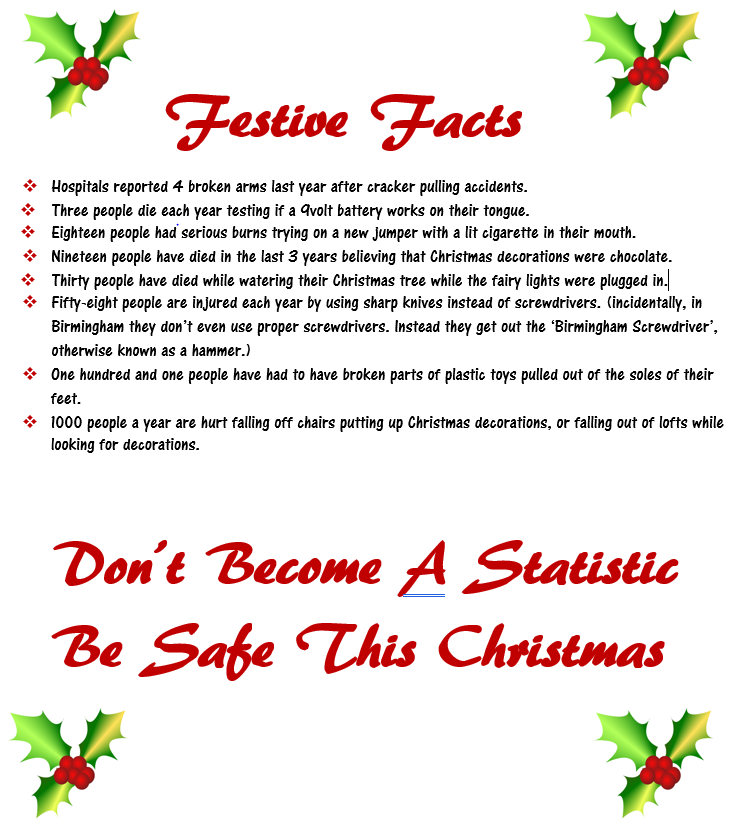
Festive Health & Safety Facts

12th December 2016/0 Comments/in Christmas, Health & Safety/by GAR Training Services


https://www.gar-trainingservices.co.uk/wp-content/uploads/2016/12/christmas-picture.png 505 773 GAR Training Services http://www.gar-trainingservices.co.uk/wp-content/uploads/2015/08/gar-training-services-logo.png GAR Training Services2016-12-12 12:08:502018-09-25 18:14:43Festive Health & Safety Facts

CDM failing costs £800k

2nd December 2016/0 Comments/in Health & Safety/by GAR Training Services

Crest Nicholson Operations, the principal contractor of a large housing development project in Surrey, has been fined after a worker was run over by a heavy goods vehicle (HGV).

Reading Crown Court was told that Crest Nicholson had failed to effectively plan and manage the workplace transport. The Health and Safety Executive (HSE) said the accident could have been avoided had the company ensured workers stayed behind the pedestrian barriers and did not walk on the road, and prevented HGVs reversing hundreds of metres at once.

Crest Nicholson pleaded guilty to breaching reg 36(1) of the Construction (Design and Management) Regulations 2007, which states that pedestrians and vehicles must be able to move around a construction site without risks to safety. It was fined £800,000 plus £10,984 costs.

HSE inspector John Berezansky said: “David Cole suffered life-changing injuries because Crest Nicolson did not properly manage and monitor the workplace transport of their construction site.”

https://www.gar-trainingservices.co.uk/wp-content/uploads/2016/12/cdm-2015.gif 156 200 GAR Training Services http://www.gar-trainingservices.co.uk/wp-content/uploads/2015/08/gar-training-services-logo.png GAR Training Services2016-12-02 14:17:332016-12-02 14:20:04CDM failing costs £800k

Chainsaws, are you workers safe?

22nd January 2016/0 Comments/in chainsaws/by GAR Training Services

Tree work can be a high-risk activity. Effective training is an essential requirement for ensuring this work is carried out both safely and efficiently.

All workers must be adequately trained and competent to carry out their job safely. The Health and Safety at Work Act 1974 places general duties on employers and the self-employed to provide Health and Safety training and information.

The Approved Code of Practice, Safe Use of Work Equipment, supporting regulation 9 of The Provision and Use of Work Equipment Regulations 1998 (PUWER 98) sets a minimum standard of competence for people using chainsaws in tree work, stating that all workers should have received appropriate training and obtained a relevant certificate of competence or national competence award.

The Management of Health and Safety at Work Act 1999 requires employers to provide Health and Safety Training for workers when:-

  • They first start work, ie induction training
  • They are exposed to new or increased risks
  • They require refresher training – this is recommended at specific intervals for certain high-risk activities
  • A specific weakness is identified in an operators ability

Workers new to a task should receive adequate information and training to do their work safely and effectively. Dependant on the nature of the work, the training may vary from simple instruction through to nationally recognised courses providing comprehensive basic training.

For more specific advice or training requirements, please contact via the website

https://www.gar-trainingservices.co.uk/wp-content/uploads/2016/01/beaver.jpg 300 300 GAR Training Services http://www.gar-trainingservices.co.uk/wp-content/uploads/2015/08/gar-training-services-logo.png GAR Training Services2016-01-22 12:12:352016-01-22 12:20:41Chainsaws, are you workers safe?
Page 1 of 212
Search Search

Latest

  • NPORS Appointed Persons Novice Course availability27th September 2018 - 8:30 am
  • When is it too cold to work outside?6th March 2018 - 1:32 pm
  • Kidde Recall 40m Fire Extinguishers25th January 2018 - 2:31 pm
  • Common Work at Height Myths20th April 2017 - 12:21 pm
  • Half of Britain’s Workers drink the Night before Operating Heavy Machinery4th April 2017 - 12:37 pm

Latest News

  • NPORS Appointed Persons Novice Course availability27th September 2018 - 8:30 am
  • When is it too cold to work outside?6th March 2018 - 1:32 pm
  • Kidde Recall 40m Fire Extinguishers25th January 2018 - 2:31 pm
  • Common Work at Height Myths20th April 2017 - 12:21 pm

Quick Links

  • About
  • Plant Training
  • Online Training
  • Lifting Operations

Contact

2 Radcliffe Row
Abbotswood Common Road
Romsey, Hampshire SO51 0DU

T: 01794 874531

E: info@gar-trainingservices.co.uk

Follow

  • Facebook
  • LinkedIn
© Copyright GAR Training Services | Site by Deon Design
  • Link to Facebook
  • Link to LinkedIn
  • Link to Youtube
Scroll to top Scroll to top Scroll to top